
Shaping Board Culture

Board culture is the operating system that determines whether directors challenge, collaborate, and think independently. This post provides a framework for strengthening culture through The Six Habits of The Savvy Director, helping boards be resilient, thoughtful, and effective under pressure.
In today’s volatile environment, the most consequential decisions in the boardroom aren’t just about strategy, risk, or performance. They’re about how those decisions are made.
That “how” is culture.
Sometimes board culture is still treated as a soft issue – secondary to financial oversight or strategic debate. But in practice, culture is the board’s operating system. It determines whether directors challenge assumptions or defer to them, whether risks are surfaced or buried, and whether complexity is explored or simplified too quickly.
This is true whether you sit on a corporate board navigating competition and capital markets, or a non-profit board stewarding mission impact amid funding uncertainty. The context may differ, but the governance challenge remains the same.
As artificial intelligence reshapes decision-making and geopolitical forces introduce new layers of uncertainty, one pattern is becoming clear: the most effective directors aren’t those with the strongest voices, but those with the strongest presence.
Boardroom presence is the disciplined ability to remain actively engaged, intellectually curious, and constructively balanced, especially in moments of complexity, uncertainty, or tension.
This week’s blog is about how we can use the Savvy Director’s ‘Six Habits’ framework to enhance our boardroom presence and to shape board culture in an era of risk and uncertainty – when it sometimes feels like we don’t know what we don’t know.
From Authority to Presence
In many boardrooms, influence still follows a familiar pattern: the most experienced, outspoken, or authoritative voices tend to carry the most weight.
But high-functioning boards operate differently.
They are shaped by directors who listen actively, ask thoughtful questions, and create space for others to contribute. They understand that presence isn’t passive. It’s the disciplined ability to stay engaged, balanced, and curious, even when discussions become complex or uncomfortable.
This dynamic plays out across sectors:
- In corporate boards, strong executive presence or industry veterans can dominate discussions.
- In non-profit boards, founders, major donors, or deeply committed advocates can carry outsized influence.
In both cases, the risk is the same. Important diverse perspectives go unheard.
Savvy Directors, grounded in the habit of collaborating with others, take a different approach. They actively widen the conversation to build relationships.
They ask: “Whose perspective are we missing – especially those closest to risk, execution, or impact?”
When directors create space for diverse viewpoints, they improve not only the tone of discussion, but the quality of decision-making itself.
Today’s opportunities are more than risks to be managed or mitigated. Artificial intelligence and scenario planning are two examples.
AI Is a Governance Issue for Every Board
Artificial intelligence is often framed as a technical issue, but it’s really a governance issue that affects strategy, risk, ethics, and reputation.
For corporate boards, that means:
- Competitive advantage and disruption.
- Data governance and cybersecurity.
- Speed of decision-making.
For non-profit boards, the applications can be less visible but equally significant:
- Donor engagement and fundraising analytics.
- Program delivery and resource allocation.
- Ethical questions around data use, bias, and privacy.
In both contexts, the director’s role isn’t to become a technical expert. It’s to ask better questions.
This is where two of the Six Habits – Build Governance Skills and Ask Great Questions – are critical.
Savvy Directors focus on assumptions, not just outcomes. They explore implications, not just intentions. They remain curious, even when management appears confident.
Questions that elevate oversight include:
- “What assumptions are we making about the capabilities or limitations of this technology?”
- “Where could unintended consequences emerge?”
- “How might this affect trust with our customers, donors, or beneficiaries?”
Boards that fail to ask these questions risk being guided by optimism. Boards that do ask them strengthen their resilience and accountability.
Scenario Thinking – A New Core Discipline
For many boards, scenario planning used to be a periodic exercise – a tool used during annual retreats or strategic planning sessions.
That approach is no longer enough for our environment.
Today’s risks are interconnected and often simultaneous. Geopolitical instability, regulatory shifts, economic fragmentation, and technological disruption can converge quickly and unpredictably.
- Corporate boards may face supply chain disruption, trade instability, and cybersecurity threats.
- Non-profit boards may face sudden funding gaps, policy changes affecting service delivery, and surges in demand driven by external crises.
In both cases, reliance on a single “base case” is increasingly insufficient.
Savvy Directors who practice the habits of Preparing for Meetings and Thinking Independently come to discussions ready to explore alternatives.
They ask, “What combination of events – not just one – could challenge this strategy?”
They probe intersections and encourage deeper exploration, recognizing that scenario thinking isn’t about predicting the future, but strengthening preparedness.
Culture Reveals Itself Under Pressure
Board culture is easiest to observe when conditions are stable. It’s most important when they are not.
When time is short, information is incomplete and stakes are high, culture determines how the board behaves.
Do directors challenge assumptions – or defer to them? Do they explore difficult risks – or avoid them? Do they engage in thoughtful debate – or converge quickly toward agreement?
- In corporate boards, culture shapes risk-taking and innovation.
- In non-profit boards, it shapes mission integrity and stakeholder trust.
Savvy Directors understand that culture isn’t declared, it’s modeled. They separate ideas from individuals, normalize constructive challenge, demonstrate intellectual humility, and reinforce that disagreement strengthens governance.
One simple question can reset the tone of any discussion: “Are we aligned – or are we simply agreeing?”
Courage Is a Director’s Responsibility
Even in strong board cultures, there are moments when silence is the greatest risk.
A strategy feels overly optimistic, a risk is not fully explored, a respected voice dominates the conversation, or a long-standing program is no longer effective.
Moments like this require governance courage.
Savvy Directors practice the habit of demonstrating courage by speaking early before a premature consensus forms.
They contribute constructively with questions like these:
- “I may be missing something, but I’d like to explore the downside risk further.”
- “Could we take a closer look at the assumptions behind this projection?”
- “How would this decision be viewed by those most affected by it?”
In high-performing boards, these kinds of intervention aren’t disruptive. They’re essential because the purpose of a board isn’t to come to agreement as quickly as possible. It’s to provide oversight and see around corners.
"The board’s role is to make the choices that create the future for the communities they serve."
- Steven Bowman, Conscious Governance
The Six Habits in Action
Across both corporate and non-profit settings, the Six Key Habits of The Savvy Director provide a practical framework for navigating complexity and building work or volunteer relationships. Together, they shape not just individual effectiveness, but board culture itself.
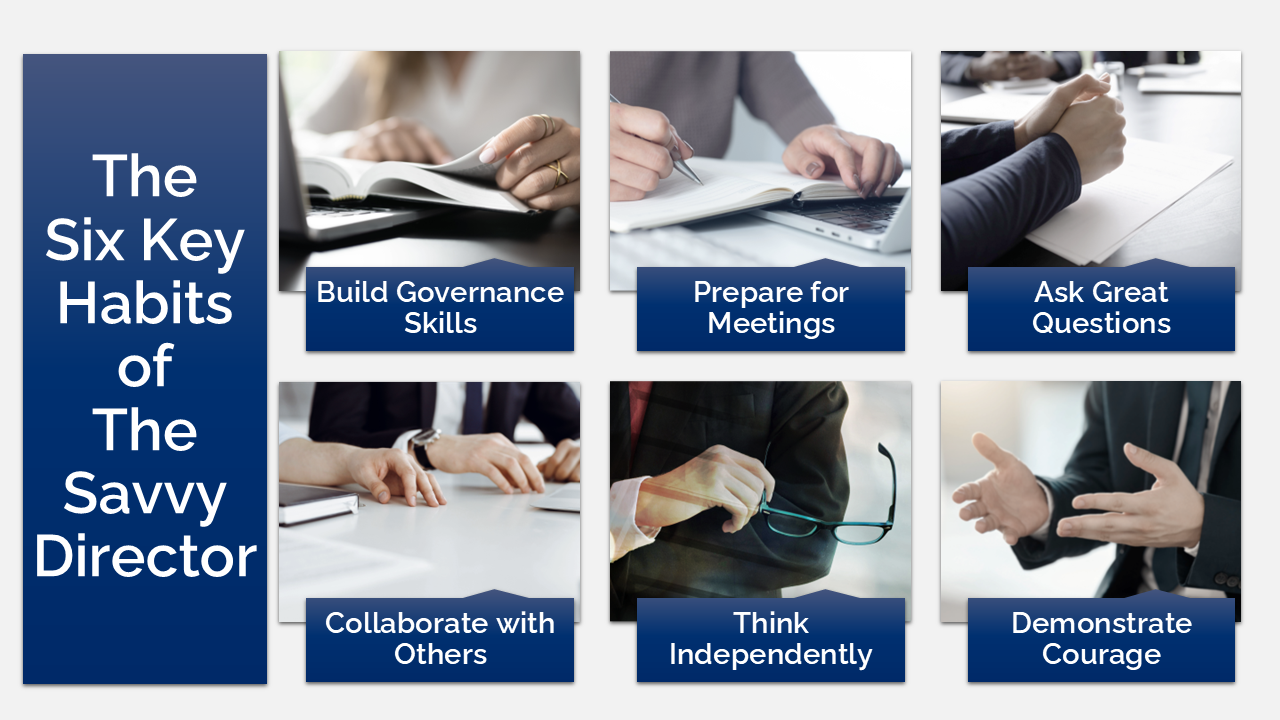
It’s tempting to think of these habits as a checklist. In practice, they function as a connected system.
For the individual director, the habits form a reinforcing cycle:
- Preparation strengthens independence.
- Independence sharpens questions.
- Questions invite collaboration.
- Collaboration builds confidence.
- Courage ensures impact.
- Continuous learning sustains effectiveness.
As they progress along their governance journey, the way that directors practice each habit naturally matures. What starts out in their first year as basic participation and skill-building, evolves over time into intentional contribution, strategic impact, and leadership.
As directors develop strength in one habit, it amplifies the others. A well-prepared director who asks thoughtful questions but lacks courage may remain silent at critical moments. A courageous director who doesn’t prepare lacks credibility. When all the habits come together, it’s a powerful combination.
From Individual Contribution to Collective Capability
The real power of the Six Habits framework becomes visible when they’re practiced across the board, not just by one or two individuals.
When several directors consistently demonstrate these habits, questions become more frequent and more insightful., independent thinking reduces Groupthink, collaboration broadens participation, and courage is normalized rather than exceptional.
That’s how culture is formed – not through intention alone, but through repeated behavior.
You can observe the difference in real time.
- On some boards, a thoughtful question is followed by silence, or a quick return to the agenda.
- On high-functioning boards, one thoughtful question leads to another, and then another – each building on the last. The discussion deepens, assumptions are tested, and perspectives expand.
That’s not accidental. It reflects a board where the Six Habits are being practiced collectively.
For Savvy Directors, the goal isn’t just personal effectiveness – it’s collective elevation.
Each director brings their PREP habits to the table. Together, those habits shape how the board thinks, challenges, and decides.
And ultimately, that’s what defines board performance.
The Culture You Create Is the Legacy You Leave
There’s no universal blueprint for governing through today’s interconnected risks. Artificial intelligence will evolve. Geopolitical conditions will shift. Economic uncertainty will persist.
What will distinguish effective boards isn’t their ability to predict these changes, but their ability to respond thoughtfully. And that capability is rooted in board culture.
Boards that lead with presence rather than dominance, and with curiosity rather than certainty, create space for better thinking, stronger decisions, and more resilient organizations.
- For corporate directors, that means sustained value creation in turbulent markets.
- For non-profit directors, it means greater mission impact when it’s needed most.
In both cases, the outcome is the same. Those organizations are guided by boards that understand how they govern is just as important as what they decide.
For Savvy Directors like you, that is the work.
Your takeaways:
- Boardroom culture can be a differentiator in an age of disruption, AI, and volatile geopolitics.
- Directors who prepare thoroughly, ask great questions, and think independently help the board see around corners.
- Governance courage is critical for surfacing risks, challenging assumptions, and protecting long-term value.
- Presence, curiosity, and constructive challenge strengthen decision-making.
- Presence isn’t about personality, charisma, or authority. It’s a disciplined way of showing up in the boardroom.
- The six habits, practiced consistently, enable a board to be agile, resilient, and effective.
Resources:
- Geopolitics, Agility, and the Board’s Expanding Mandate. Institute of Corporate Directors. April 2026.
- How to Strengthen Boardroom Culture. Dan Byrne. © 2026 Corporate Governance Institute.
- Six Key Habits of The Savvy Director. © 2024 DirectorPrep.
- IMHO: How to Get Your Board Working as a Team. Stephanie Bown. Institute of Directors New Zealand. April 2025.
- Artificial Intelligence – Essential AI Resources for Managing Boardroom Oversight. © 2026 National Association of Corporate Directors.
- Lessons Learned From a Board Culture Transformation. Rich Fields, Clare Metcalf, and Gretchen Anderson. Russell Reynolds Associates. November 2024.
- The Board’s Role in Managing Emerging AI Risks. Deneen DeFiore, Guy Gecht, Manjula Talreja, Charlie Lewis, and Rich Isenberg. McKinsey. May 2026.
- Future-Proofing Your Strategy with Scenario Planning. Peter Scoblic. Harvard Business Review. July 2020.
- In a New Era for Boards, Culture Is Key. George Anderson. Spencer Stuart. April 2018.
Thank you.
Scott
Scott Baldwin is a certified corporate director (ICD.D) and co-founder of DirectorPrep.com – an online membership with practical tools and valuable insights for directors at every stage – from first appointment to seasoned board leader.
We Value Your Feedback: Share your suggestions for future Savvy Director topics.
Comment

Scott Baldwin, ICD.D
Co-founder | Director
Scott is a knowledge entrepreneur, certified corporate director (ICD.D), and leader of a board advisory firm. He is recognized as an advisor and educator who helps boards and directors in virtually every sector improve their structure, processes, and dynamics.

